Comment Done
🔍/
✕ Reset
20 questions visible on this page
Shortcuts: / filter, Esc reset

Consider a particle of mass m in an infinite one dimensional potential well of width a. The particle is found in the state given by \psi (x) = c \left[ \sin \frac{\pi x}{a} + \frac{1}{2} \sin \frac{2 \pi x}{a} \right] (i) Calculate c. (ii) If a measurement of energy is made, what are the possible results and what are the probabilities for each one of them ?

Full Thread
CSE 200530 Marks

(i) The ground state wavefunction of a linear simple harmonic oscillator is \psi = A \exp \left( - \frac{\alpha^2 x^2}{2} \right) Calculate the constant A and the average values of x^2 and x. Given that \int_0^\infty e^{-x^2} = \frac{\pi^{1/2}}{2} (ii) How can the pure rotation spectrum of \text{H}_2 molecule be observed ? If the bond length of \text{H}_2 molecule is 0 \cdot 07417 \text{ nm}, what would be the spacing of lines in its spectrum ?

Full Thread
CSE 200510+10 Marks

Set up the time-independent Schrodinger equation for an electron moving in Coulomb field, V(r) = \frac{Ze^2}{4 \pi \varepsilon_0 r}, in polar coordinates. Solve the radial equation to get the energy eigen values.

Full Thread
CSE 200540 Marks

(i) Write the commutation relations for the position variable x and the momentum components p_x, p_y and p_z. Explain the physical significance of these relations. (ii) Calculate the de Broglie wavelength of an electron moving with a kinetic energy of 1 MeV.

Full Thread
CSE 200510+10 Marks

Discuss WKB approximation and apply the same to determine the transition probability for leakage through a potential barrier.

Full Thread
CSE 200530+30 Marks

Set up the time-independent Schrodinger equation for an electron moving in Coulomb field, V(r) = \frac{Ze^2}{4\pi\varepsilon_0 r} in polar coordinates. Solve the radial equation to get the energy eigen values.

Full Thread
CSE 200420 Marks

A hydrogen atom is in the following state : \Psi_{nlm} (r, 0) = (\sqrt{1/14}) [2\psi_{100}(r) - 3\psi_{200}(r) + \psi_{322}(r)] (i) What is the probability of finding the system in the state (200) ? (ii) What are \langle H \rangle and \langle L_z \rangle ?

Full Thread
CSE 200420 Marks

(i) Show that the radial probability density of the ground state of the hydrogen atom has a maximum at r = a. The ground state wave function of the hydrogen atom is given by \psi (r) = \frac{1}{\sqrt{\pi a^{3/2}}} e^{-r/a} where a is the Bohr radius. (ii) Calculate the Larmor frequency of a spin 1/2 particle in a magnetic field B.

Full Thread
CSE 200310+10 Marks

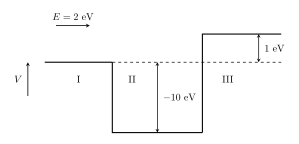
(i) Explain what do you understand by Heisenberg uncertainty principle. Using this principle, determine the energy of the ground state of a one dimensional simple harmonic oscillator. (ii) An electron having an energy 2 eV is travelling in the region where V(x) varies as shown below:

Physics Diagram cse-q-5-135-fig-1

Calculate the de Broglie wavelength of the electron in regions I, II and III.

Full Thread
CSE 200310+10 Marks

Obtain an expression from which the energy eigen values can be determined.

Full Thread
CSE 200315 Marks

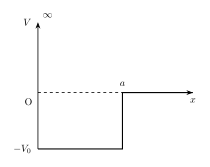
A particle of mass m, with energy E such that -V_0 < E < 0, is trapped in a potential wall as shown below :

Physics Diagram cse-q-5-159-fig-1

Write time independent Schrodinger equation in regions (i) 0 < x < a and (ii) x > a.

Full Thread
CSE 200315 Marks

Show that for at least one bound state to exist. a^2 V_0 \ge \frac{h^2 \pi^2}{8m}

Full Thread
CSE 200330 Marks

Number at non-interacting electrons are confined in a cube of volume L^3. Obtain an expression for the Fermi energy.

Full Thread
CSE 200330 Marks

= 0$. What is the significance of this commutation relation ? (ii) Show that the Pauli Matrices anti-commute.

Full Thread
CSE 200315+5 Marks

Derive an expression for the electrical conductivity of metals on the basis of free electron theory of metals.

Full Thread
CSE 200220 Marks

(i) The wave function of a particle is . \psi(x) = A \exp \left( -\frac{x^2}{a^2} + i k_0 x \right) Find the expectation values of position (x) and momentum (p) for the particle. (ii) A 200 eV increase in the energy of an electron changes its De Broglie wavelength by a factor of two. Calculate the initial De Broglie wavelength of the electron.

Full Thread
CSE 200210 Marks

Distinguish between a classical and a quantum mechanical harmonic oscillator. Explain the existence of zero point energy.

Full Thread
CSE 200215 Marks

Solve the one dimensional Schrodinger wave equation with potential: V(x) = \begin{cases} 0 & \text{for } x < -a \\ V_0 & \text{for } -a < x < a \\ 0 & \text{for } x > 0 \end{cases}

Full Thread
CSE 200220 Marks

A particle is in a quantum system with a parabolic potential well. (i) Using appropriate method find the ground state energy. (ii) Obtain an expression for the ground state.

Full Thread
CSE 2001(30+10) Marks

(i) Write down the matrix representation of the energy operator of a linear oscillator. (ii) A linear oscillator is prepared in the state given by \psi(x) = 1/\sqrt{5} \{\hat{\psi}_0(x) + \sqrt{2} \hat{\psi}_1(x) + \sqrt{2} \hat{\psi}_2(x)\} Evaluate the energy of the oscillator in this state.

Full Thread
CSE 2001(5+15) Marks

Document & Diagram Scanner

Clean whiteboard & high-contrast scan with automatic image enhancement

Filter:
-- × -- pxCompressed: -- KB--% saved